
Calculate the Effective Isotropic Radiated Power (EIRP) and system gain for your wireless setup. Input your transmitter power, cable losses, and antenna gain to determine the total radiated power. Essential for planning wireless bridge links and ensuring compliance with regulatory limits.
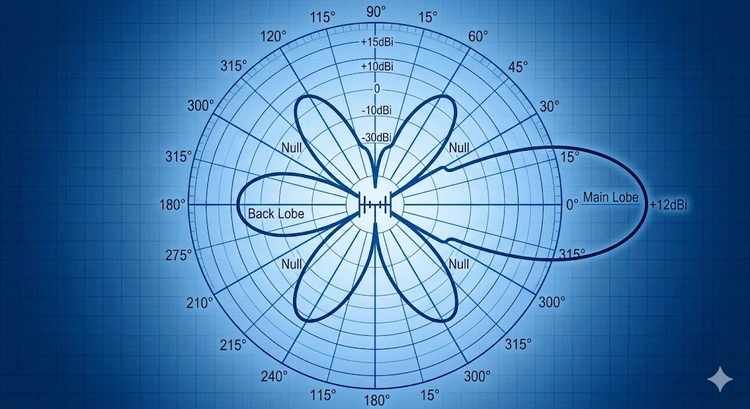
Antenna gain measures how effectively an antenna focuses radio energy in a particular direction compared to an isotropic (theoretical omnidirectional) radiator. Expressed in dBi (decibels relative to isotropic), higher gain means the antenna concentrates energy into a narrower beam, reaching farther in one direction while covering less area around it.
Understanding antenna gain is fundamental to wireless networking. Whether you are optimizing router placement for better WiFi coverage or planning a long-range wireless bridge, the antenna gain determines how far your signal can travel. Use our Free Space Path Loss Calculator to see how distance and frequency affect the signal.
Different antenna designs offer different gain levels and radiation patterns. Choosing the right type depends on whether you need broad coverage (like a home router) or focused long-range connectivity (like a point-to-point bridge):
| Antenna Type | Typical Gain (dBi) | Beam Width | Pattern | Common Use |
|---|---|---|---|---|
| Rubber Duck (omni) | 2-3 | 360° H / 75° V | Omnidirectional | Consumer routers, handheld radios |
| Dipole | 4-6 | 360° H / 60° V | Omnidirectional | Access points, base stations |
| Patch (small) | 7-9 | 70-80° | Directional | Indoor APs, client bridges |
| Panel (large) | 12-16 | 30-60° | Directional | Sector coverage, medium range |
| Yagi | 10-14 | 25-45° | Directional | Point-to-point, TV reception |
| Parabolic Dish | 20-30+ | 5-15° | Highly directional | Long-range bridges, backhaul |
| Sector | 12-17 | 60-120° | Sectoral | WISP base stations, stadiums |
Pro Tip: For home use, the omnidirectional antennas on your router are usually sufficient. But if you have a specific dead zone in one direction, replacing a stock antenna with a higher-gain directional antenna can solve the problem without adding a mesh node or extender. Just remember that higher gain means narrower coverage — you are trading breadth for distance.
Effective Isotropic Radiated Power (EIRP) is the total power that would need to be radiated by an isotropic antenna to produce the same signal strength as your actual antenna in its direction of maximum gain. The formula is straightforward:
EIRP (dBm) = Tx Power (dBm) - Cable Loss (dB) + Antenna Gain (dBi)For example, a 20 dBm transmitter with 1.5 dB cable loss and a 24 dBi parabolic dish produces: 20 - 1.5 + 24 = 42.5 dBm EIRP (about 17.8 watts). This value is critical for link budget calculations and regulatory compliance.
The cable connecting your radio to the antenna introduces signal loss. Longer cables and higher frequencies result in greater loss. Always use the shortest cable possible and high-quality connectors:
| Cable Type | Loss at 2.4 GHz (dB/100ft) | Loss at 5 GHz (dB/100ft) | Typical Use |
|---|---|---|---|
| LMR-100 | 32 | 48 | Short pigtails only |
| LMR-200 | 16 | 24 | Short runs (< 10 ft) |
| LMR-400 | 6.7 | 10.8 | Standard outdoor runs |
| LMR-600 | 4.4 | 6.7 | Long runs, low loss |
| LMR-900 | 3.0 | 4.6 | Maximum performance |
Each connector (N-type, SMA, RP-SMA) adds approximately 0.2-0.5 dB of loss. For long-range outdoor links, minimize connectors and use LMR-400 or better cable. For indoor setups, the short cables on consumer routers introduce negligible loss. If you need to run cable to a remote antenna, consider using Ethernet cable with a PoE-powered outdoor access point instead, which avoids RF cable loss entirely.
For typical home WiFi, antenna gain directly affects your coverage area. A router with 5 dBi antennas provides roughly twice the range of one with 2 dBi antennas in the same direction — but with a narrower vertical beam. This is why router manufacturers often include adjustable antennas so you can angle them for multi-floor coverage.
If you are experiencing slow WiFi at distance, check whether a higher-gain antenna would help before investing in a mesh system. For the 2.4 GHz vs 5 GHz decision, remember that antenna gain is frequency-dependent — a 5 dBi antenna at 5 GHz has a narrower beam than at 2.4 GHz due to the shorter wavelength.
The relationship between dBm (logarithmic) and milliwatts (linear) is important when comparing radio specifications. This reference table helps translate between the two scales:
| dBm | Milliwatts | Watts | Common Device |
|---|---|---|---|
| 0 | 1 | 0.001 | Bluetooth Class 3 |
| 4 | 2.5 | 0.0025 | Bluetooth Class 2 |
| 10 | 10 | 0.01 | Low-power WiFi |
| 17 | 50 | 0.05 | Typical phone WiFi |
| 20 | 100 | 0.1 | Standard WiFi router |
| 23 | 200 | 0.2 | High-power router / AP |
| 27 | 500 | 0.5 | Enterprise AP, FCC limit area |
| 30 | 1000 | 1.0 | Maximum for most applications |
Selecting an antenna depends on your coverage requirements. Use these guidelines when planning your wireless network, especially when setting up access points or connecting two routers:
dBi stands for decibels relative to an isotropic radiator — a theoretical antenna that radiates equally in all directions. A 6 dBi antenna focuses energy to produce 6 dB more signal in its preferred direction than an isotropic antenna would with the same input power.
Not always. Higher gain focuses the signal into a narrower beam. For a single-story home, a 5 dBi omnidirectional antenna provides good all-around coverage. A 15 dBi directional antenna would cover a long distance in one direction but leave other areas without signal.
dBi measures gain relative to an isotropic radiator; dBd measures relative to a dipole antenna. Since a dipole has ~2.15 dBi gain, the conversion is: dBi = dBd + 2.15. Most WiFi equipment specs use dBi.
If your router has detachable antennas (RP-SMA connectors), yes. Upgrading from 2 dBi stock antennas to 9 dBi aftermarket antennas can significantly improve range in the antenna's main beam direction. This is a cost-effective alternative to range extenders.
EIRP (Effective Isotropic Radiated Power) is the total effective power your system radiates. It matters for two reasons: regulatory compliance (FCC limits EIRP in unlicensed bands) and link budget calculations. Too much EIRP violates the law; too little means your signal won't reach.
Ideally under 3 dB. Every 3 dB of cable loss cuts your radiated power in half. For outdoor installations, use LMR-400 cable and keep runs under 50 feet. Better yet, use a PoE-powered outdoor access point to eliminate the RF cable entirely.
Yes. Antenna gain works in both directions. A 10 dBi antenna improves both the transmitted signal and the received signal by 10 dB. This is why high-gain antennas are so effective for long-range links — they benefit both sides of the communication.

About Tommy N.
Tommy is the founder of RouterHax and a network engineer with 10+ years of experience in home and enterprise networking. He specializes in router configuration, WiFi optimization, and network security. When not writing guides, he's testing the latest mesh WiFi systems and helping readers troubleshoot their home networks.
 |
 |
 |
 |
Search
Popular Tools
Browse Guides
Promotion for FREE Gifts. Moreover, Free Items here. Disable Ad Blocker to get them all.
Once done, hit any button as below
|
|
|
|